2025-2026
Listed below are all the 2026 ISRR sessions recorded.
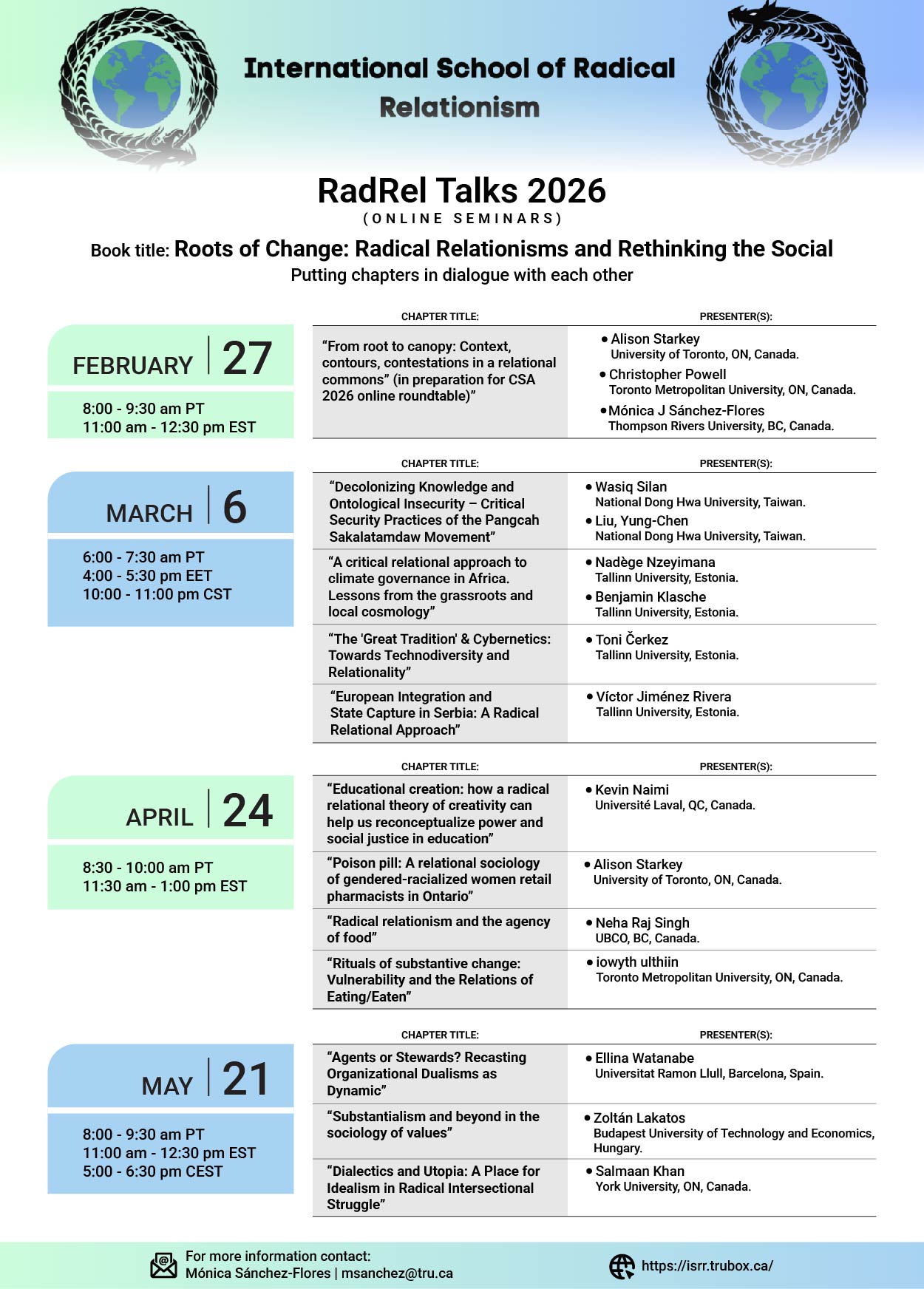
* Please note we are using Pacific Time (PT) or Pacific Daylight-saving Time (PDT); do check against the time at your location.
May 21st, 2026.
Session 4: Challenging Western thinking through collective transformation
Today’s sessions challenged some of the most foundational assumptions about leadership, politics, values, and social struggle, asking us to rethink how we come to know, relate, and organize collectively. Across the presentations, one theme kept emerging: the tension between individualistic, “substantialist” ways of understanding the world and more relational, interconnected approaches to society, power, and change. PhD candidate Ellina Watanabe explored the contrast between Agency Theory and Stewardship Theory, Dr. Zoltán Lakatos critically examined how “Western values” are often treated as universal, objective, and superior within political discourse, and Dr. Salmaan Khan took us with storytelling on a reflection about radical relationism, dialectics, and intersectional struggle, moving beyond mechanical explanations of oppression toward the lived, emotional, and relational dimensions of power. These sessions did not offer easy answers; they created urgent questions and opened powerful conversations about relationality, embodiment, storytelling, coloniality, and the possibilities of collective transformation.
April 24th, 2026.
Session 3: Transformative future through relations
In this seminar session take us to a meaningful question that allows us to imagine relations as a transformative way for education, healthcare, and ecological ethics, emphasizing the deep entanglement of humans, non-humans, and systems. The discussion challenges individualistic Western paradigms by reframing creativity as a relational force rather than a personal talent, proposing a “flat ontology” where humans are shaped by the world as much as they shape it. Through case studies on the gendered racialization of pharmacy work, the participants illustrate how systemic violence manifests in daily interactions, requiring a shift toward understanding emotions as relational energy and practice. The session further critiques the “one world” narrative of colonial capitalism, advocating for pluriversality and the recognition of food and land as agents that facilitate ancestral healing and decolonization. Finally, they reflect on the violence of objectification and the necessity of maintaining an “animate sense of the world,” where sensitive responsiveness to materiality replaces the drive for mastery and fixedness.
March 6th, 2026.
Session 2: Decolonizing knowledge, governance, and technology
This seminar session explores Radical Relationality as a critical framework for addressing global challenges, ranging from the “sinister” politics of big tech to climate governance and decolonization. Challenging the “great tradition” of Western political thought that prioritizes disembodied information over the human condition, the speakers highlight how contemporary cybernetics and Eurocentric structures recenter dualisms that separate individuals from their material and social environments. The discussion bridges academic and local contexts, examining how indigenous land-based education in Taiwan and African cosmologies offer paths for ontological security and epistemic justice. By critiquing unequal knowledge production in European integration and the extractivism inherent in global capitalism, they emphasize that meaningful solutions to modern crises require moving toward plural, embodied, and interconnected ways of being. This session reflects a collective endeavor to move beyond fragmented Western paradigms, fostering deeply connected worlds through an engagement with non-Western epistemologies and relational ethics.
February 27th, 2026.
Session 1. Rethinking the world through relationality
In this conversation, Alison Starkey, Christopher Powell, and Mónica Sánchez-Flores explore Radical Relationality as a way of understanding the world through interconnected relationships rather than fixed essences or isolated entities. Challenging Western assumptions that separate humans from nature, the speakers emphasize that relationality extends beyond the human and recognizes the entangled connections that shape our lives, communities, and environments. The discussion introduces an emerging collaborative project aimed at building networks across academic and community spaces through shared research tools, mapping initiatives, and dialogue. They reflect on how relational thinking can be practiced in everyday life, moving from rigid definitions toward more open, plural, and interconnected understandings of meaning. This project explores how relational approaches can help bridge silos, foster mutual understanding across differences, and contribute to imagining and rebuilding more connected worlds.